
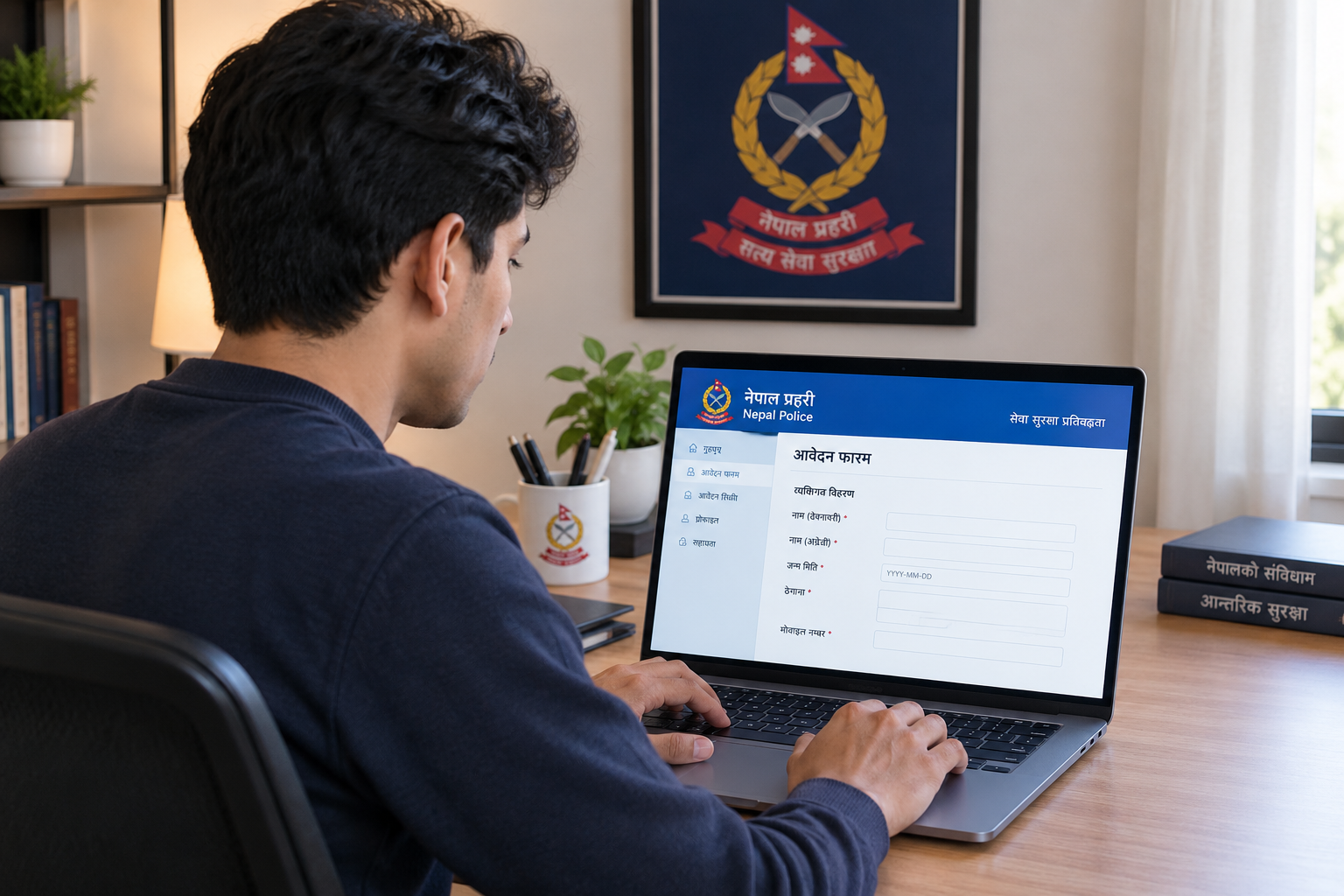
Making a police report online in Nepal means something different depending on why you need one — and that mix-up trips up more people than you’d expect. Some readers land here wanting to report a crime or theft, others need a police clearance certificate for a visa or job abroad, and some are trying to report online fraud.
This guide separates those three paths clearly, using the official Nepal Police website and its dedicated portals as the source for every step. By the end, you’ll know exactly which online channel applies to your situation, what to prepare beforehand, and when an in-person visit to a police station is still required by law.
First, Know Which “Police Report” You Actually Need
The phrase “police report” covers three different processes in Nepal, and each has its own online system:
- A general complaint or grievance (उजुरी तथा गुनासो) — for reporting an incident, requesting police assistance, or flagging a concern to the Nepal Police
- A Police Clearance Certificate (चारित्रिक प्रमाणपत्र) — the “character certificate” required for visas, overseas jobs, higher study, or immigration, confirming you have no criminal record
- A cybercrime complaint — for online fraud, harassment, hacking, or other internet-based offenses, handled by the dedicated Cyber Bureau
Knowing which one applies to you before you start saves a lot of back-and-forth later, since each system asks for different documents.
How to File a General Complaint Online
The Nepal Police official website (nepalpolice.gov.np) hosts a dedicated grievance and complaint form, listed under “उजुरी तथा गुनासो” (Complaint and Grievance) in the site’s top navigation.
- Go to the Nepal Police website and locate the Complaint/Grievance section
- Fill in your name, contact number, and a clear description of the incident
- Attach supporting evidence such as photos or documents where relevant
- Submit the form through the official portal
This channel works well for reporting concerns, requesting police attention to an issue, or flagging something that doesn’t require an urgent in-person response. For serious or ongoing criminal incidents, an in-person report is still the more reliable route — more on that below.
How to Apply for a Police Clearance Certificate Online
If you searched for a “police report” because you need one for a visa, job abroad, or immigration paperwork, you’re actually looking for the Police Clearance Certificate, and Nepal Police runs a dedicated online portal for this: opcr.nepalpolice.gov.np.
- Visit the OPCR (Online Police Clearance Report) portal
- Register for an account and log in
- Fill in your personal details, including citizenship information and purpose of the certificate
- Upload the required documents (citizenship certificate, passport if applying for use abroad, and a recent photograph)
- Submit your application and track its status through your account
The same portal includes a cross-verification tool, which lets employers, embassies, or other third parties confirm that a submitted certificate is genuine — useful to know if you’re submitting your certificate somewhere and want to reference how it can be verified.
How to Report Cybercrime Online
For online fraud, harassment, hacking, or other internet-based offenses, Nepal Police operates a separate Cyber Bureau with its own reporting channel at cyberbureau.nepalpolice.gov.np. This bureau specializes specifically in digital crimes, which require different evidence handling than a standard complaint — screenshots, transaction records, and account details are typically far more useful here than they would be for a general grievance.
When You Still Need to Visit a Police Station in Person
Not everything can be done online, and Nepali law treats certain reports differently. A First Information Report (FIR) — the formal written report police prepare when a cognizable criminal offense occurs — generally still needs to be filed in person at the nearest police station or Metropolitan Police Office. This matters for serious incidents like theft, assault, or property crimes where an official investigation needs to start immediately.
When filing an FIR in person:
- Go to the nearest police station and speak to the duty officer
- Explain the incident clearly and provide all relevant details
- Police will prepare a written FIR based on your statement, or you can submit one yourself in writing
- Read the FIR carefully before signing it, and request a copy for your own records
- Once registered, police begin investigation, which may include evidence collection and witness statements
If a police officer refuses to register your complaint or FIR, Nepal Police maintains a complaint helpline for reporting misconduct, which exists specifically to address this kind of situation.
The Nepal Police Mobile App
Alongside the web portals, Nepal Police also offers an official mobile app, available on both the Google Play Store and Apple App Store. It provides another route to file complaints and stay updated with police services without needing to navigate the full website on a small screen.
Documents You’ll Commonly Need
Requirements vary by which process you’re using, but across most online submissions, have these ready:
- Citizenship certificate (clear photo or scan, front and back)
- Passport, if the report or certificate is needed for use abroad
- Recent passport-size photograph
- Full address details, including district, municipality, and ward
- Active mobile number and email, since most portals use these for verification and status updates
- Purpose statement, particularly for clearance certificates (study, work, immigration, etc.)
9. Comparison Table
| What You Need | Where to Go | Fully Online? |
|---|---|---|
| General complaint or grievance | nepalpolice.gov.np — Complaint/Grievance form | Yes |
| Police Clearance Certificate | opcr.nepalpolice.gov.np | Mostly — document upload required |
| Cybercrime report | cyberbureau.nepalpolice.gov.np | Yes |
| FIR for a criminal offense | Nearest police station | No — in-person required |
10. Pros & Cons
Pros of Nepal Police’s Online Systems
- Clear separation between complaints, clearance certificates, and cybercrime through dedicated portals
- Application status can be tracked online rather than requiring repeat visits
- A mobile app extends access beyond the desktop website
- The clearance certificate portal includes a public verification tool for third parties
Cons of Nepal Police’s Online Systems
- Serious criminal incidents still require an in-person FIR, which surprises many first-time users
- Documentation requirements aren’t always obvious until partway through the form
- The website’s bilingual (Nepali/English) navigation can be confusing for first-time visitors
- Processing times for clearance certificates depend on verification steps and aren’t fully predictable
11. Expert Tips
- Identify your exact need before opening any portal. A visa applicant and a theft victim need completely different systems, even though both might search “police report online.”
- Keep document photos clean and legible. Blurred citizenship or passport scans are one of the most common reasons online applications get delayed.
- Use the OPCR cross-verification tool proactively if you’re submitting your clearance certificate to an embassy or employer, so you can confirm it displays correctly before they check it.
- For urgent incidents, go in person rather than waiting on an online form. Online complaint channels aren’t designed for emergencies requiring immediate police response.
- Save your application or reference number from any portal immediately after submission — it’s typically required to track status later.
12. Common Mistakes
- Confusing a police clearance certificate with a general complaint. These use entirely different portals and serve different purposes.
- Assuming a criminal incident can be fully resolved online. An FIR for theft, assault, or similar offenses still requires an in-person police station visit.
- Submitting blurry or incomplete document scans, which is one of the most common causes of application delays.
- Not saving the acknowledgment or reference number after submitting a complaint or application.
- Using unofficial third-party websites that mimic Nepal Police branding — always confirm you’re on an official nepalpolice.gov.np domain or subdomain before entering personal details.
A police report online in Nepal isn’t a single form — it’s really three separate systems depending on what you need: the general complaint portal, the OPCR clearance certificate system, or the Cyber Bureau for digital crimes. Identify which one fits your situation, gather your documents in advance, and remember that serious criminal incidents still call for an in-person FIR at your nearest police station.
Found this breakdown helpful? Share it with someone navigating Nepal’s police portals for the first time, or drop a comment with your own experience using these systems.
